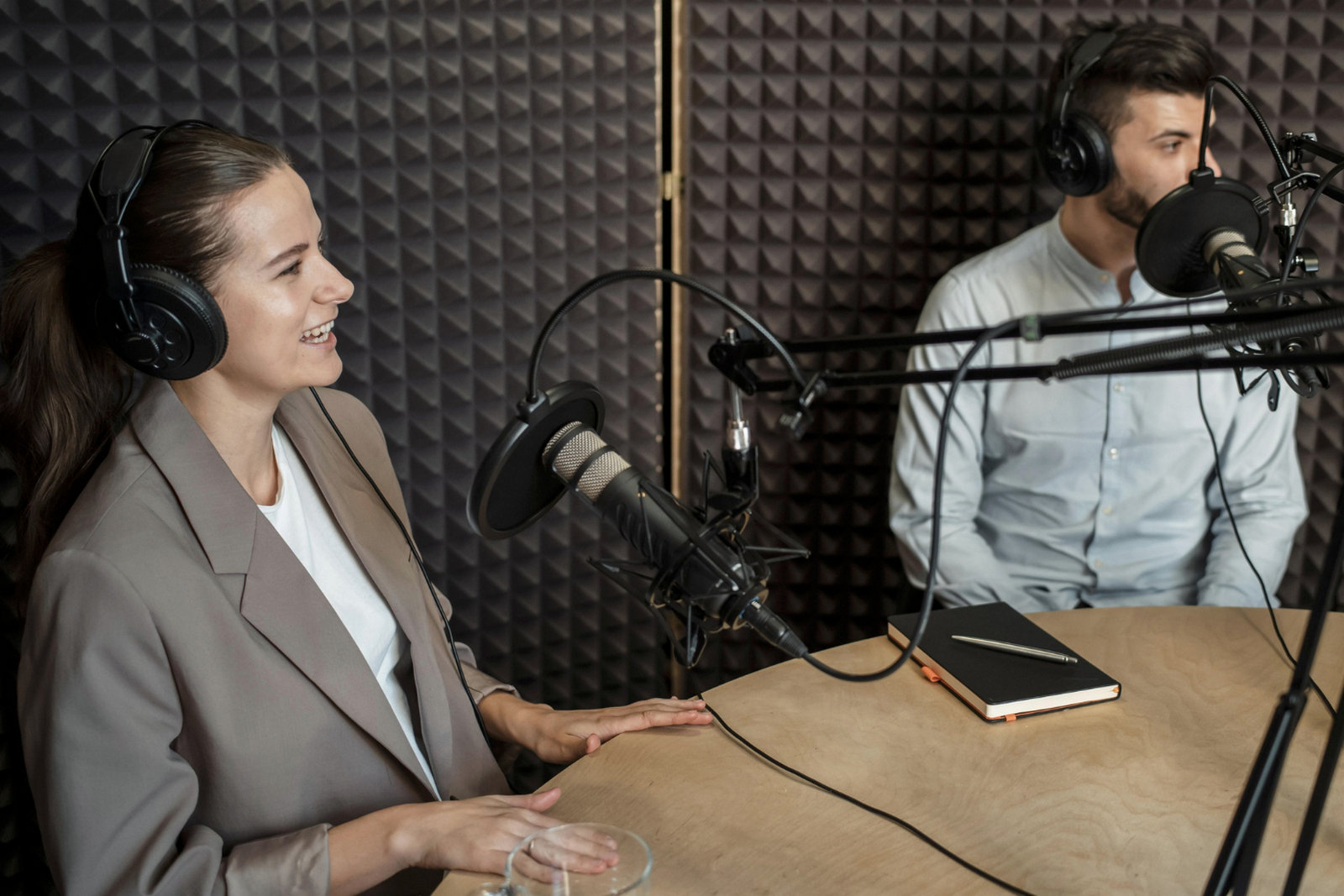


A B2B podcast can be an effective sales tool, but only when it is not treated as just another conversation to be published online. In a business model, a podcast should support a specific process: building relationships with decision-makers, shortening the distance to clients, educating the market, strengthening expertise, generating topics for sales conversations and creating content that can be reused many times in sales and marketing.
Not every B2B podcast pays off. If a company does not have a clearly defined target group, does not know why it is recording episodes, cannot distribute content and relies only on random listens, the podcast will quickly become a cost. However, if it is planned as a format that supports sales, it can become one of the most valuable tools for expert communication.
In 2025 and 2026, B2B podcasts are increasingly evaluated not only by the number of plays, but by their impact on relationships, pipeline, leads, customer engagement and the ability to create multiple formats from a single recording. In a Databox survey of more than 100 B2B brands, the most commonly used podcast distribution methods included social media clips, newsletters, blog posts, guests’ networks and short video materials.
What is a B2B podcast?
A B2B podcast is an audio or video format created by a company, expert or brand whose clients are other companies. It can take the form of guest interviews, an expert series, industry commentary, client interviews, trend analysis, case studies or an educational series for potential clients.
Unlike an entertainment podcast, a B2B podcast usually does not need hundreds of thousands of plays to be profitable. In many industries, it is enough for it to reach the right people: business owners, marketing directors, management boards, HR managers, people responsible for purchasing, sales, technology, finance or business development.
That is why, in B2B, the quality of the audience is often more important than the size of the audience. A podcast listened to by 300 relevant people can be more valuable for business than a piece of content watched by 30,000 random users.
B2B podcast as a sales tool – how does it work?
A B2B podcast usually does not sell like performance advertising. It rarely works in a model where someone listens to an episode, clicks a link and immediately buys a service worth tens of thousands of zlotys. Its strength lies elsewhere.
A podcast works at the earlier and middle stages of the sales process. It helps build trust before a client speaks to a salesperson. It shows the company’s competence without aggressive selling. It creates a reason to contact a potential client. It makes it easier to invite experts, partners, clients and decision-makers to a conversation. It also creates a content library that the sales team can use in follow-ups, presentations and sales conversations.
A well-planned B2B podcast can support sales on several levels:
- It builds brand expertise – the company regularly shows that it understands market problems, the language of clients and the business context.
- It warms up leads – a potential client can get to know the company, its experts and its way of thinking before the first sales conversation.
- It provides materials for salespeople – episodes, shorts, quotes and conversation fragments can be sent to clients as answers to specific objections.
- It helps with account-based marketing – a podcast can be a reason to invite important people from selected companies to a conversation.
- It extends the life of content – one episode can be turned into a blog post, newsletter, reels, LinkedIn posts, quotes and campaign fragments.
When does a B2B podcast pay off?
A B2B podcast pays off when it is part of a larger sales and marketing system, not a standalone project published “because others are recording one too.”
When you sell a service or product that requires trust
A B2B podcast works especially well in industries where the client does not make an impulse decision. This applies to consulting, technology, legal, financial, HR, marketing, educational, medical, real estate services and all areas where relationships and expert credibility matter.
If, before buying, the client needs to understand the problem, compare approaches, trust the team and see the company’s competence, a podcast can genuinely shorten the path to a sales conversation.
When you have knowledge that cannot be shown well in an ad
Some companies have strong expertise, but it is difficult to show it in a short ad. A podcast allows you to develop a topic, talk about experience, show examples and explain nuances.
This is especially important where the competitive advantage is not the “lowest price”, but the way of working, experience, quality of consulting, methodology, process or industry knowledge.
When the target group is narrow but valuable
A B2B podcast does not have to reach a mass audience. If a company sells expensive services, high-margin products or solutions for a specific industry, even a small number of the right recipients can have high value.
Example: a podcast for HR directors in companies employing more than 500 people will not have the same reach as a lifestyle podcast. But if decision-makers listen to it regularly, its sales value can be very high.
When the podcast supports relationships with specific companies
One of the strongest uses of a B2B podcast is building relationships with guests. Inviting a potential client, partner, industry expert or opinion leader to a conversation often opens doors that a classic cold email would not open.
It is not about aggressive selling during the recording. It is about creating a natural space for conversation, getting to know the other side’s perspective and building a relationship. In B2B, this is often much more valuable than another automated sales message.
When you can reuse one episode many times
A B2B podcast becomes much more profitable if one episode does not end its life after being published on YouTube or Spotify. The highest return appears when one recording is turned into many materials: shorts, posts, an article, a newsletter, quotes, presentation fragments and materials for the sales department.
This approach is consistent with a visible trend in B2B content marketing: companies no longer treat a podcast as a single file, but as a source of multiple content assets. Industry reports and analyses point out that B2B brands increasingly measure podcasts by their impact on pipeline, customer engagement and content use across many channels, not only by the number of downloads.
When does a B2B podcast not pay off?
A B2B podcast is not a good solution for every company. It can be expensive, time-consuming and ineffective if there is no strategy, process or clear goal.
When the company does not know who it is speaking to
If the target group is too broad, the podcast loses focus. Episodes start being “for everyone”, which in practice means for no one. In B2B, this is especially risky because communication effectiveness depends on precision.
A podcast for “entrepreneurs” will be harder to position than a podcast for owners of service companies employing 20-100 people, marketing directors in e-commerce or founders of software houses.
When the podcast is not connected to the sales process
A podcast may have great guests and interesting conversations, but if it does not answer clients’ questions, does not address sales-related problems and does not support topics important to the company, its business impact will be limited.
The mistake is creating episodes solely around the host’s interests, without checking whether these topics help clients move through the decision-making process.
When the company looks only at the number of listens
In B2B, the number of plays matters, but it should not be the only measure of success. A podcast can have moderate reach and still influence sales if the right people are listening. On the other hand, large reach does not necessarily mean business value if the audience is not made up of potential clients.
Better questions are: does the podcast help arrange sales conversations? Do clients mention episodes during meetings? Do salespeople use podcast fragments? Do guests return in other business conversations? Does podcast content generate inquiries, website visits, newsletter replies or LinkedIn activity?
When there is no distribution plan
Publishing an episode is only the beginning. If a company uploads a podcast to YouTube and waits for “the algorithm to do its job”, it will usually be disappointed.
A B2B podcast requires distribution: LinkedIn posts, short clips, a newsletter, a blog post, publication by the guest, sending it to clients, using it in the sales process and placing it in the right places on the website. Databox indicates that B2B brands distribute podcasts not only as full episodes, but also through social clips, newsletters, blog posts and short video materials.
When the company is not ready for consistency
A podcast does not have to be released every week, but it should have a rhythm. If a company publishes three episodes, then disappears for half a year and later returns without a plan, it is difficult to build audience habits and trust in the format.
In B2B, a seasonal approach can work well. Instead of promising a weekly podcast for the whole year, you can prepare a season of 6-10 episodes around one topic, industry or client problem.
B2B podcast vs. traditional sales – where is the difference?
Traditional sales often starts with sales contact: a message, phone call, meeting or presentation. A podcast works earlier. It allows you to build presence in the client’s mind before they are ready to talk.
This matters because B2B purchasing decisions are often long, multi-stage and involve several people. The client needs time to trust the provider. A podcast can help in this process because it regularly delivers arguments, examples and proof of competence.
However, it does not replace sales. A podcast should not be treated as a substitute for a salesperson, CRM, follow-ups and client conversations. It works best as a tool that supports sales, not as the only customer acquisition channel.
How does a B2B podcast support the sales funnel?
Awareness stage
At this stage, a podcast helps the client name the problem. Episodes can cover trends, mistakes, market changes, new regulations, industry challenges or questions that appear before the purchasing process begins.
Example: a consulting company can record an episode about why ESG strategy implementations in companies fail. A software house can discuss when it is worth building an application from scratch and when it is better to develop an existing tool.
Consideration stage
Here, the podcast helps compare approaches, cooperation models and possible solutions. This is the place for expert conversations, case studies, process explanations and showing selection criteria.
Example: a marketing agency can record an episode about when to invest in SEO and when to invest in paid campaigns. An HR company can discuss how to choose a recruitment model for specialist positions.
Decision stage
At the bottom of the funnel, a podcast can answer objections. Episodes can cover costs, risks, cooperation process, clients’ most common questions, implementation, delivery time and results.
This is especially important because good audio-video material can work repeatedly. A salesperson does not have to explain the same thing from scratch every time – they can send the client an episode or fragment that answers a specific concern.
How to measure the effectiveness of a B2B podcast?
A B2B podcast should be measured differently from a reach campaign. Listens, views and subscriptions alone are not enough.
It is worth monitoring:
- the number of sales conversations in which the client mentioned the podcast,
- the number of invited guests from the target group,
- the number of business relationships started thanks to the podcast,
- the number of leads that had contact with episodes,
- website visits from episode descriptions,
- LinkedIn activity after publishing fragments,
- the use of episodes by the sales team,
- the number of materials created from one recording,
- the podcast’s role in client education,
- the podcast’s impact on inquiries, deals and pipeline.
In B2B, qualitative measurement is also important. If clients quote episodes, reply to the newsletter, ask for contact after watching a fragment or understand the company’s way of working faster, that is also a sales effect.
What topics work well in a B2B podcast?
The best B2B podcast topics sit at the intersection of three areas: clients’ problems, the company’s expertise and current market changes.
Good topics include:
- the most common mistakes clients make before buying a service,
- costs and cooperation models,
- solution comparisons,
- case studies and behind-the-scenes project insights,
- conversations with clients,
- comments on industry trends,
- explaining difficult concepts,
- answers to questions asked to salespeople,
- analysis of client objections,
- practical guides for decision-makers.
Weak topics are those that are too general, disconnected from the purchasing process or created solely to boost the brand’s ego. A B2B podcast should not be a series of self-promotional conversations about how great the company is. It should help clients make better decisions.
B2B podcast in video format – why does it have an advantage?
In 2026, a B2B podcast increasingly means a videocast, meaning a conversation recorded as both audio and video. The reason is simple: video creates more distribution opportunities.
Video material can be published on YouTube, cut into reels, used on LinkedIn, embedded in a blog article, added to a newsletter and used in a sales campaign. According to podcast market analyses, the video format is gaining importance, and some audiences treat discussion-based video materials on YouTube as podcasts.
In B2B, this is especially important because the purchase of business services and solutions is often based on trust in people. Video shows not only the content, but also the experts’ personalities, conversation style, confidence and brand atmosphere.
B2B podcast as a source of content for sales and marketing
The greatest value of a B2B podcast is not only the episode itself. The greatest value is the ability to create an entire content ecosystem from it.
From one 45- or 60-minute recording, you can prepare a full YouTube episode, an audio version, 3-5 shorts, a blog post, a newsletter, LinkedIn posts, graphic quotes, fragments for a sales presentation, a transcript, an FAQ section and materials for a remarketing campaign.
This means the cost of producing one episode is spread across many formats. That is exactly why a B2B podcast can be more profitable than a single ad or one-off article. One recording can power brand communication for several weeks.
When should you start a B2B podcast?
It is worth starting a B2B podcast when the company meets at least several conditions:
it has a clearly defined target group, sells a service or product that requires trust, has experts ready for regular conversations, knows clients’ most common questions, has a sales process, can use content across several channels and wants to build its brand long-term.
You do not need to start with a huge format right away. Sometimes the best solution is a pilot: 3-5 episodes around one topic, recorded in a professional studio and tested in sales and marketing.
When should you not start a B2B podcast?
It is not worth starting a B2B podcast if the company has no distribution plan, does not know who it is speaking to, does not want to involve experts, expects immediate leads after the first episode or treats the podcast as a trendy add-on with no connection to the business.
A podcast will not fix a weak offer, replace a sales strategy or solve a lack of market communication. It can, however, strengthen a company that has knowledge, experience and a clear idea of how it helps clients.
How much does a B2B podcast cost?
The cost of a B2B podcast depends on whether the company wants to record only raw material or receive a finished edited episode. At OMG PRIME STUDIO, studio rental costs PLN 600 net per hour, with a minimum rental time of 2 hours. This means that a basic recording session without editing starts from PLN 1,200 net.
If the company wants to receive a finished videocast with editing, prices start from PLN 800 net for material up to 20 minutes. Videocast production up to 30 minutes costs PLN 1,000 net, up to 45 minutes – PLN 1,200 net, up to 60 minutes – PLN 1,400 net, and up to 90 minutes – PLN 2,200 net. Longer formats are quoted individually.
This means that a B2B podcast can be started with a relatively small budget, especially if the company prepares the topic well, invites the right guests and uses the recording across several channels.
How to plan a B2B podcast so that it supports sales?
First, you need to define the goal. A podcast can be used to educate the market, build expertise, strengthen client relationships, reach specific companies, support salespeople or generate content for social media.
Then you need to define the audience. A podcast for founders is recorded differently than one for marketing directors, management boards or technical specialists.
Next, it is worth preparing a list of topics based on real client questions. Good sources include sales conversations, inquiry emails, client objections, briefs, LinkedIn comments, Google Search Console queries and the most common problems reported by salespeople.
Only at the end should you choose the name, set design, intro and visual identity. Form is important, but in B2B, the strategic usefulness of the content comes first.
B2B podcast at OMG PRIME STUDIO
OMG PRIME STUDIO in Warsaw is a space for recording podcasts, videocasts, expert interviews and video materials for companies. The studio works well both for a one-off recording and for producing an entire B2B podcast season.
On-site, you can record a conversation with professional sound, 3-camera video, technical support, studio personalization and the option to prepare a finished edited material. This is a good solution for companies that want to focus on content, guests and the sales use of the podcast, rather than organizing equipment, lighting, cameras and sound.
If you want to check whether a B2B podcast makes sense for your company, start with a simple question: do we have topics that help clients make purchasing decisions? If so, a podcast can be one of the best ways to present these topics in a credible, expert and multi-channel format.
FAQ – B2B podcast as a sales tool
Can a B2B podcast generate leads?
Yes, but it usually does not work as directly as performance advertising. A B2B podcast generates leads through trust-building, market education, relationships with guests, use of content in sales and distribution of fragments across channels such as LinkedIn, YouTube, newsletter or the company website.
When does a B2B podcast pay off?
A B2B podcast pays off when the company has a clearly defined target group, sells a product or service that requires trust, can regularly create valuable content and uses episodes in the sales and marketing process.
When does a B2B podcast not pay off?
A B2B podcast does not pay off when the company has no strategy, does not know who it is speaking to, has no distribution plan, cannot use content in sales and expects immediate results after one or two episodes.
Does a B2B podcast need many listeners?
No. In B2B, audience quality is more important than the number of plays. A podcast listened to by several hundred relevant decision-makers can be more valuable than content with large but random reach.
Is an audio podcast or videocast better?
For most B2B companies, a videocast is more practical because one recording can be turned into a full video episode, audio version, reels, LinkedIn posts, quotes, a blog post and sales materials. Audio still makes sense, but video offers more distribution opportunities.
How should you measure the effects of a B2B podcast?
It is worth measuring not only listens, but also the number of sales conversations in which the podcast appears, the number of leads who had contact with episodes, LinkedIn activity, use of episodes by salespeople, relationships with guests and the impact of content on the pipeline.
How many episodes should you record to evaluate the effectiveness of a B2B podcast?
It is best to start with a pilot season of 3-5 episodes. One episode is not enough to assess the potential of the format. A short season makes it possible to test topics, reception, the recording process, distribution and client reactions.
Does a B2B podcast help with SEO?
Yes, if episodes are transformed into text content: transcripts, blog articles, FAQ sections, episode descriptions and guides answering specific client questions. This allows a podcast to support brand visibility in Google and in answers generated by AI models.